
Understanding different mirror types is crucial for choosing the right one for any space, from enhancing decor to practical applications like safety and energy efficiency. From standard glass mirrors to specialized types like safety, two-way, and decorative mirrors, knowing their properties ensures you make an informed choice that perfectly suits your needs and enhances your home or project. This guide breaks down the common mirror types, their uses, and what makes them unique.
Ever walked into a room and felt that a certain mirror just… worked? Or perhaps you’ve picked out a mirror online, only to find it doesn’t quite do what you imagined once it’s hanging on your wall. Choosing the right mirror can feel a bit like a guessing game, especially with so many options out there. But it doesn’t have to be! Understanding the different ‘types’ of mirrors – what they’re made of and how they behave – is the key to making smart decisions for your home. We’re going to demystify this for you, making sure you feel confident about picking the perfect reflector for any purpose.
What’s the Difference? Understanding Mirror Basics
At its core, a mirror is a surface that reflects light, allowing us to see an image of ourselves or our surroundings. The magic happens with a reflective layer applied to a substrate, usually glass. The quality and type of this reflective layer, along with the substrate and any protective coatings, determine the mirror’s performance, durability, and aesthetic appeal. Think of it like paint on a wall – different formulations do different jobs, and so do different mirror types.
The most common type you’ll encounter is a standard glass mirror. These are made by depositing a thin layer of metal, typically silver or aluminum, onto the back of a piece of glass. This metal layer is what reflects the light. Then, a protective coating, often copper and then a final paint layer, is applied to prevent the metal from oxidizing and darkening over time. The glass itself provides a smooth, flat surface for a clear reflection.
But not all mirror surfaces are created equal. The type of glass, the thickness of the reflective coating, and the specific metals used can lead to variations in the reflectivity, clarity, and longevity of the mirror. For instance, a higher quality silvering process can result in a brighter, more distortion-free reflection.
Common Mirror Types Explained
Let’s dive into the most common mirror types you’ll find and what makes them suitable for different applications. Knowing these will help you select the best option for your bathroom, hallway, dressing room, or even a special DIY project.
1. Standard Glass Mirrors (Silvered or Aluminum Mirrors)
These are the workhorses of the mirror world, found in most homes and businesses. They offer a clear, accurate reflection and are generally cost-effective. They are made using a process where silver or aluminum is applied to the back of a glass pane, followed by protective layers.
- Silvered Mirrors: Traditionally made using a chemical process to deposit a thin layer of silver. These often offer superior reflectivity and color accuracy, making them a preferred choice for high-quality applications where color fidelity is important, like in some cosmetic mirrors or art installations.
- Aluminum Mirrors: Made by sputtering aluminum onto the glass. They are more economical than silvered mirrors and are highly durable and resistant to corrosion, making them a popular choice for general use, particularly in areas with higher humidity where corrosion could be a concern.
Pros: Widely available, cost-effective, good reflectivity, clear images.
Cons: Can be brittle, susceptible to damage if not handled carefully, standard bathroom mirrors can eventually develop dark spots due to moisture ingress over time.
2. Safety Mirrors
Safety is paramount, and safety mirrors are designed with this in mind. They are typically standard mirrors with an added layer of protection to prevent shattering into sharp shards if broken. This makes them ideal for high-traffic areas, children’s rooms, or any place where accidental breakage could pose a hazard.
- Mirror with Safety Backing: The most common type of safety mirror involves applying a backing film (often vinyl or Mylar) to the back of the mirror. If the glass breaks, this film helps to hold the pieces together, reducing the risk of injury.
- Acrylic or Polycarbonate Mirrors: These aren’t technically glass mirrors. Instead, they are made from plastic materials like acrylic (plexiglass) or polycarbonate. They are virtually unbreakable, offering a much higher level of safety. However, they can be more prone to scratching and may not offer as perfectly flat or distortion-free a reflection as glass mirrors. Their lighter weight also makes installation easier.
Pros: Significantly reduces the risk of injury from broken glass, durable (especially acrylic/polycarbonate). Acrylic/polycarbonate versions are lightweight.
Cons: Acrylic/polycarbonate can scratch more easily than glass. Reflections might be slightly less crisp than high-quality glass mirrors. Safety backing on glass mirrors adds a small cost.
Where to use them: Gyms, dance studios, children’s playrooms, areas near entrances or high-traffic zones, boat interiors, RVs.
3. Two-Way Mirrors (One-Way Mirrors / Surveillance Mirrors)
Often seen in television shows or movies, two-way mirrors allow you to see out, but people on the other side can’t see in. This effect is achieved through a very thin, semi-transparent reflective coating. The mirror works best when the lighting conditions are controlled: it needs to be much brighter on the side where you want to see out from than on the side where you want to conceal yourself.
- How they work: Light from the brightly lit side bounces off the reflective coating and is seen as a mirror. Light from the dimmer side passes through the thin reflective layer to the brighter side, where it’s reflected back to the observer. About 70% of the light is reflected, and 30% is transmitted.
- Material: Typically made from glass with a specialized thin film coating.
Pros: Allows for observation without being seen, creates privacy while maintaining visibility.
Cons: Only works under specific lighting conditions (requires a significant difference in light levels). Can be expensive.
Where to use them: Security observation rooms, experimental psychology settings, sometimes as decorative elements to create a unique visual effect.
For more detailed information on the physics behind how these work, you can refer to resources like the National Institute of Standards and Technology (NIST), which often delves into material science and optics.
4. Decorative Mirrors
These mirrors are all about aesthetics. They come in a vast array of shapes, sizes, frame styles, and even finishes. The focus here is on enhancing your interior design rather than purely functional reflection.
- Framed Mirrors: The frame can be anything from ornate carved wood or metal to minimalist painted designs. The frame significantly influences the mirror’s style, fitting into traditional, modern, rustic, or eclectic decors.
- Frameless Mirrors: These offer a sleek, modern look. Their edges are often beveled or polished for a refined finish. They can make a space feel larger and brighter without the visual weight of a frame.
- Antique or Faux-Antique Mirrors: These are designed to look aged, often with intentional blemishes, darker spots, or a distressed finish to mimic the patina of old mirrors. They add character and vintage charm.
- Coloured Mirrors: Mirrors can be tinted with various colours (e.g., bronze, gold, grey, pink, blue) to add a unique visual element and affect the colour of reflected objects.
- Mosaic or Tiled Mirrors: Mirrors that are broken into small pieces and arranged in a mosaic pattern, often around a frame or as a wall feature.
- Artistic Mirrors: Mirrors shaped into unique forms, with interesting textures, or incorporated into larger art pieces.
Pros: Enhance interior design, add visual interest, create focal points, make spaces feel larger and brighter.
Cons: Can be more expensive due to design and materials. Reflection quality might be secondary to appearance, especially with heavily textured or tinted mirrors.
5. Full-Length Mirrors (Standing or Wall-Mounted)
These are simply mirrors designed to reflect your full body. They are a staple in bedrooms, dressing rooms, and entryways, allowing you to check your outfit before heading out.
- Wall-Mounted Full-Length Mirrors: These are hung directly on a wall. They can be single large mirrors or a series of smaller mirrors.
- Door-Mounted Full-Length Mirrors: Designed to hang over the top of a door. They are a great space-saving option.
- Standing Full-Length Mirrors: These mirrors rest on a stand, often with an easel back or a swivel mechanism. They can be moved around more easily and don’t require drilling holes in the wall. Some standing mirrors also have built-in storage or shelves.
Pros: Essential for checking full outfits, can make rooms feel larger. Standing mirrors offer flexibility in placement.
Cons: Can be heavy and require secure mounting. Standing mirrors take up floor space.
6. Vanity Mirrors / Makeup Mirrors
These are typically smaller mirrors designed for close-up tasks like applying makeup, shaving, or intricate grooming. Quality and magnification are key here.
- Illuminated Vanity Mirrors: Many modern vanity mirrors have built-in LED lighting around the edge to provide bright, even illumination, mimicking natural daylight for accurate colour representation.
- Magnifying Mirrors: These mirrors have one side that offers a standard 1x magnification and the other side with 3x, 5x, 7x, or even 10x magnification. This is crucial for detailed work.
- Swivel or Extendable Mirrors: Often mounted on flexible arms or pivots, allowing you to position them precisely where you need them.
Pros: Excellent for detailed grooming tasks, magnification is very useful, built-in lights improve visibility.
Cons: Magnification side can be disorienting if used for general viewing. Requires a power source if illuminated.
7. Specialty Mirrors
Beyond the common types, there are mirrors designed for specific functions and environments.
- Antimicrobial Mirrors: These mirrors have coatings that inhibit the growth of bacteria and mold, making them ideal for healthcare settings, bathrooms, or high-touch areas prone to germs.
- Heated Mirrors (Demister Mirrors): Often found in bathrooms, these mirrors have a heating element embedded in the backing. They gently warm the mirror surface to prevent condensation from forming after a steamy shower, ensuring the mirror remains clear.
- Security Mirrors (Convex Mirrors): These mirrors bulge outwards, providing a wide-angle view. They are commonly used in retail stores, on blind corners, or in industrial settings to improve visibility and prevent accidents. They distort the true size and distance of objects.
- One-Way Privacy Film Mirrors: Similar in function to two-way mirrors but achieved by applying a film to a regular mirror or window on one side. This film allows light to pass through from one side and reflects it from the other, depending on the lighting.
Pros: Designed for specific functional needs (hygiene, clarity, security), solve particular problems.
Cons: Can be more expensive, specific applications may require professional installation.
Choosing the Right Mirror for Your Needs
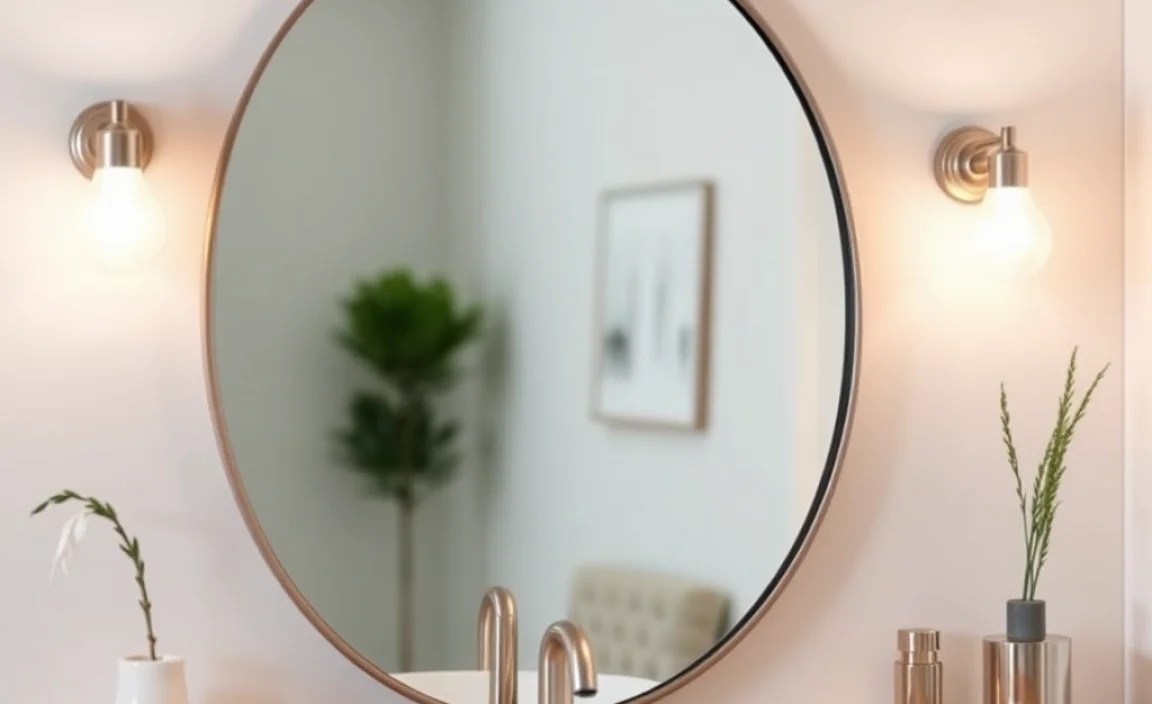
Selecting a mirror isn’t just about picking one that looks nice. Consider these factors:
1. Intended Use
What will the mirror be used for?
- Functional Reflection (getting dressed, shaving): Prioritize clarity, accurate colour, and appropriate size. Full-length, vanity, and standard glass mirrors are good choices.
- Decorative Accent: Focus on style, shape, frame, and how it complements your decor. Decorative, antique, or coloured mirrors are ideal.
- Safety: If in a high-traffic area, children’s room, or gym, opt for safety mirrors (acrylic, polycarbonate, or glass with safety backing).
- Observation/Privacy: For controlled environments, two-way mirrors are the solution.
- Enhanced Visibility: In security or industrial settings, convex mirrors are necessary for a wide field of view.
2. Size and Scale
A tiny mirror in a vast hallway will look lost, while an oversized mirror in a small bathroom can overwhelm the space. Measure the area where the mirror will go and consider the proportions. A good rule of thumb for a bathroom mirror above a vanity is to have it about two-thirds the width of the vanity.
3. Room Lighting
Mirrors reflect light. In a dimly lit room, a mirror can help bounce natural or artificial light around, making the space feel brighter and larger. Consider mirrors with frames that won’t absorb too much light or opt for frameless designs.
4. Style and Decor
The mirror should integrate seamlessly with your existing interior design. A modern minimalist room might suit a frameless or sleek metal-framed mirror, while a traditional room would benefit from an ornate, carved wood frame.
5. Budget
Prices vary significantly based on size, materials, brand, and any special features (like heating elements or antimicrobial coatings). Determine how much you’re willing to spend before you start shopping.
Table: Mirror Types at a Glance
Here’s a quick comparison to help you decide:
| Mirror Type | Primary Use | Key Features | Considerations | Typical Cost |
|---|---|---|---|---|
| Standard Glass (Silver/Aluminum) | General reflection, decor | Clear, accurate reflection, cost-effective | Susceptible to breakage/moisture damage in untreated forms | $ – $$ |
| Safety Mirror (Glass w/ backing) | High-traffic areas, children’s rooms, public spaces | Shatter-resistant, holds glass shards together | Slightly heavier/thicker than standard | $$ |
| Acrylic/Polycarbonate Mirror | Safety-critical applications (e.g., RVs, gyms, children’s rooms) | Virtually unbreakable, lightweight | Prone to scratching, reflection may be less precise | $$ – $$$ |
| Two-Way Mirror | Observation, controlled privacy | See-through from one side under specific lighting | Requires significant light difference to function | $$$ |
| Decorative Mirror | Interior design, accent piece | Variety of styles, shapes, frames, finishes | Reflection quality may be secondary to aesthetics | $$ – $$$$ |
| Full-Length Mirror | Outfit checks, space enhancement | Reflects entire body | Needs adequate wall space or floor space if standing | $$ – $$$ |
| Vanity/Makeup Mirror | Detailed grooming, makeup application | Magnification, illumination options | Often requires electricity if illuminated | $$ – $$$ |
| Heated (Demister) Mirror | Bathrooms | Prevents fogging/condensation | Requires electrical connection | $$$$ |
| Convex Security Mirror | Wide-angle surveillance, blind spots | Expansive field of view, safety enhancement | Distorts size and distance, not for clear reflections | $$ – $$$ |
Installation and Care Tips for Mirrors
Once you’ve chosen your mirror, proper installation and care will ensure it looks great and lasts for years.
Installation:
Surface Preparation: Ensure the wall is clean, dry, and structurally sound. For heavier mirrors, always locate studs in the wall to ensure secure mounting. If studs aren’t available or conveniently placed, use heavy-duty wall anchors appropriate for your wall type (drywall, plaster, etc.).
Hardware: Use the hardware recommended by the mirror manufacturer. If none is provided, choose robust hanging hardware like D-rings and wire (for lighter mirrors), mirror clips (for frameless mirrors), or French cleats (for very large or heavy mirrors). Always use a level to ensure your mirror hangs straight!
Safety First: For large or heavy mirrors, consider having a second person help you lift and hang it. Wear safety glasses when drilling or handling glass, especially if you’re working with older mirrors which might be more prone to breakage.
Acrylic Mirrors: These can often be attached with strong double-sided tape or a mirror adhesive designed for plastics. Avoid harsh chemicals that can damage the surface.
For detailed guidance on hanging various types of wall decor.
