
Ready to remove cabinets? This guide breaks down how to safely and effectively remove cabinets, step by step. We’ll cover preparing the area, detaching cabinets from walls and countertops, and handling different cabinet types, ensuring you can tackle this DIY project with confidence and ease.
Ever stared at your kitchen or bathroom cabinets, wishing for a fresh start or an upgrade? Removing cabinets can seem like a big job, especially if you’re new to DIY projects. Old cabinets might be worn out, or you might be planning a complete renovation. Whatever the reason, knowing how to remove them properly is key to a smooth remodel and avoiding damage to your walls or yourself. Don’t worry, it’s a very manageable task with clear instructions! This guide will walk you through everything you need to know, from gathering your tools to the final removal, making the process simple and stress-free.
Tools and Safety Gear You’ll Need

Before we swing into action, let’s make sure you have the right gear. Having the correct tools not only makes the job easier but also much safer. Think of this as your essential toolkit for cabinet removal.
Essential Tools:
- Screwdrivers (Phillips and Flathead): You’ll need these for unscrewing mounting screws.
- Pry Bar: This is crucial for gently loosening cabinets that might be stuck.
- Stud Finder: To locate the wall studs where cabinets are usually secured.
- Utility Knife: For cutting through any paint or caulk sealing the cabinet edges.
- Drill/Impact Driver: Makes removing screws much faster and easier.
- Adjustable Wrench or Pliers: Handy for disconnecting any plumbing or hardware.
- Putty Knife: Useful for scraping away old caulk or adhesive.
- Level: While removing, it can help identify where it was level, which might indicate where it’s attached.
- Hammer: For tapping the pry bar or other tools gently if needed.
- Shims: Small wooden wedges to help support cabinets as you loosen them.
- Buckets or Tubs: Essential if you’re disconnecting plumbing.
Safety Gear:
- Safety Glasses: Protect your eyes from falling debris or splinters.
- Work Gloves: Prevent cuts and splinters, and improve grip.
- Dust Mask: Important if dealing with old paint, drywall dust, or potential mold.
- Knee Pads: For comfort and protection when working in awkward positions.
Step-by-Step Guide to Removing Cabinets
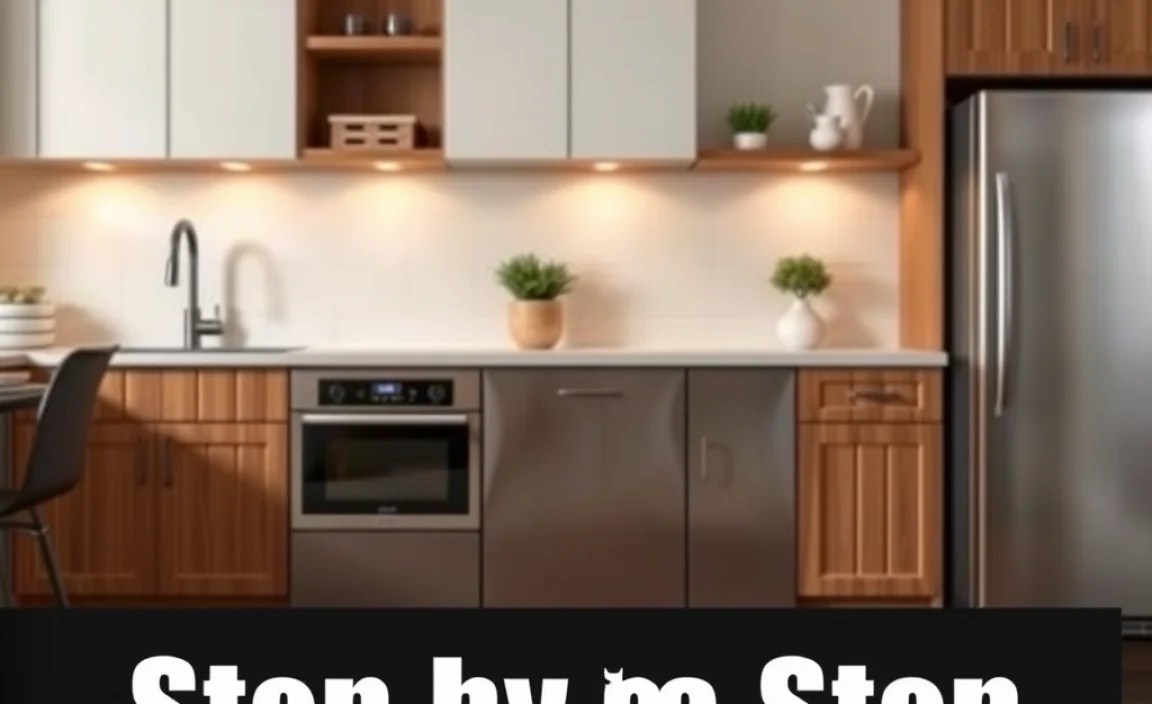
Now that you’re equipped, let’s get started on removing those cabinets. We’ll break this down into manageable steps, so you can follow along with ease.
Step 1: Prepare Your Work Area and Protect Surfaces
This is a critical first step. You want to avoid damaging your flooring or other parts of your kitchen or bathroom. Think of it like putting on a safety net before a performance – essential for a smooth outcome!
- Clear the Space: Remove everything from inside and around the cabinets. This includes dishes, food items, cleaning supplies, and anything stored on top.
- Protect Flooring: Lay down drop cloths, old blankets, or cardboard on the floor in front of and beneath the cabinets. This will protect against dropped tools, debris, and scratches.
- Shut Off Utilities: If your cabinets house sinks or appliances, it’s vital to shut off the water supply and electricity. For sinks, turn off the hot and cold water valves under the sink. For appliances like a garbage disposal or dishwasher, locate the circuit breaker and flip it off. Always double-check that power and water are off before proceeding. For guidance on electrical safety, consult resources from the <a href=”https://www.nfpa.org/education-and-research/home-fire-” target=”_blank” rel=”noopener noreferrer”>National Fire Protection Association (NFPA).
Step 2: Remove Cabinet Doors and Drawers
Taking off doors and drawers first makes the cabinet boxes lighter and less awkward to handle later. This is usually the easiest part!
For Cabinet Doors:
- Locate Hinges: Open the cabinet doors. You’ll see hinges attached to the door and the cabinet frame.
- Unscrew Hinges: Using a screwdriver, carefully unscrew the screws attaching the hinges to the cabinet frame. Some hinges have release clips, which might be easier. If so, press the clip while gently pulling the door away.
- Support the Door: Have someone help you support the door as you remove the last screws, or place a block of wood underneath to catch it.
- Store Doors: Label each door and set it aside in a safe place.
For Drawers:
- Pull Drawers Out: Empty the drawers completely.
- Identify Drawer Slides: Look for the drawer slides on the sides of the drawer box and inside the cabinet opening.
- Release Slides: Most drawer slides have a small lever or clip that you need to push or pull to disengage the drawer from the slide. Refer to your drawer slide manufacturer’s instructions if unsure. Sometimes, you can simply unscrew the drawer from its slides.
- Remove Drawer: Once disengaged, pull the drawer out.
- Store Drawers: Keep drawers and their components together.
Step 3: Disconnect Plumbing and Appliances (If Applicable)
If your cabinets are connected to a sink, faucet, dishwasher, or garbage disposal, this step is crucial and requires extra caution.
- Turn Off Water Supply: As mentioned in Step 1, ensure the water valves under the sink are completely turned off.
- Disconnect Supply Lines: Use an adjustable wrench or pliers to disconnect the water supply hoses from the faucet. Have a bucket or tub ready to catch any residual water.
- Disconnect Drain Pipes: Loosen the slip nuts connecting the P-trap to the sink tailpiece and the wall drainpipe. Again, have a bucket ready.
- Remove Faucet and Sink: Once plumbing is disconnected, you can typically lift the sink out. Faucets are usually secured from underneath with nuts.
- Disconnect Appliances: For dishwashers and garbage disposals, disconnect the water inlet hose, drain hose, and electrical connections. For garbage disposals, you might also need to detach it from its mounting assembly under the sink. Always refer to the appliance’s manual for specific removal instructions.
Important Note: If you’re uncomfortable with plumbing or electrical work, it’s best to call a professional plumber or electrician for this part of the job.
Step 4: Locate and Remove Cabinet Mounting Screws
This is where the cabinet box itself is secured to the wall. You’ll need to find where it’s attached.
- Use Stud Finder: Most cabinets are screwed into wall studs for maximum stability. Run a stud finder along the wall at the top and bottom edges of the cabinet to find these anchor points. Mark the stud locations lightly with a pencil.
- Check Inside for Screws: Look inside the cabinet boxes. Screws are typically driven through the back of the cabinet into the wall studs, or through the cabinet’s upper and lower support rails into the studs. Sometimes screws are hidden behind shelf supports or drawer slides.
- Score Paint/Caulk: If the cabinet is sealed with paint or caulk along its edges or where it meets the wall, use a utility knife to score a line around the cabinet. This helps prevent paint from peeling off your walls when the cabinet moves.
- Start Unscrewing: Using your drill or screwdriver, remove all the mounting screws you can find. If the screws are stripped or difficult to remove, you might need a screw extractor or a stronger tool.
Step 5: Gently Loosen and Remove the Cabinet
With the screws out, the cabinet should be ready to come free. Here’s how to do it carefully.
- Assess Stability: Before prying, ensure all visible screws are removed. Check if the cabinet is still held by anything else, like adhesive or hidden fasteners.
- Use a Pry Bar (Carefully!): Place a shim or a piece of wood between the cabinet and the wall to protect the wall surface. Insert the tip of the pry bar between the cabinet and the wall (or countertop, if attached). Gently apply pressure to pry the cabinet away from the wall. Work your way slowly along the edges, using shims to keep it from shifting back.
- Check for Countertop Clearance: If you have a countertop, ensure you’re not damaging it as you pry. The cabinet might be resting on the countertop; you may need to lift it up and over the backsplash or countertop edge.
- Get Help for Larger Cabinets: Upper cabinets, especially, can be heavy and awkward. It’s highly recommended to have at least one other person to help support the cabinet as it loosens and to guide its removal.
- Support and Lower: Once loosened, have your helper(s) support the cabinet. Slowly and carefully lower it away from the wall. If it’s a large base cabinet, you might need to tilt it slightly to maneuver it out.
Step 6: Clean Up and Inspect
You’ve done it! The cabinet is out. Now for the final touches.
- Inspect the Wall: Check the wall for any damage. Patch any holes or gouges with spackle or drywall compound.
- Clean the Cabinet: If you plan to reuse the cabinet, clean it thoroughly. If you’re discarding it, ensure you dispose of it properly according to local regulations.
- Clean the Area: Remove all drop cloths, tools, and debris. Sweep or vacuum the floor thoroughly.
Types of Cabinet Installations and Removal Nuances

While the steps above cover most scenarios, different installation methods can present unique challenges. Understanding these can save you headaches.
| Cabinet Type | Typical Fasteners | Removal Considerations |
|---|---|---|
| Face Frame Cabinets | Screws through the face frame into studs, or through a hanging rail. | Screws are often visible on the front edges. Careful prying needed to avoid damaging the frame or nearby cabinets. |
| Frameless (Euro) Cabinets | Screws through the cabinet walls into studs, often with specialized mounting plates. | May have more hidden mounting points. Check the interior walls of the cabinet for screws. |
| Cabinets Mounted on Countertops | Often secured to the backsplash and/or the underside of the countertop. Sometimes adhered with construction adhesive. | Carefully check for any adhesive. You may need to carefully cut through the adhesive with a utility knife or putty knife before prying. |
| Custom Built-ins | Can be secured in numerous ways – screws, L-brackets, glue, or even built directly into the wall structure. | Requires careful inspection for all attachment points. May involve more complex disassembly. |
| Cabinets with Integrated Appliances (e.g., built-in ovens) | Secured through the back, sides, and often to the appliance itself. | Appliance must be disconnected and often removed first or in conjunction with the cabinet. Consult appliance manuals. Check out Energy Saver’s guide to kitchen appliances for related information. |
Removing Cabinets Glued to Walls or Countertops
Sometimes, cabinets are installed not just with screws but also with strong construction adhesive or even tile mastic along the back or edges. This makes them much harder to remove.
- Identify Obstructions: Look for areas where the cabinet seems unusually difficult to budge, even after removing all screws. You might see dried adhesive residue.
- Score Deeply: Use your utility knife to carefully score along the seam between the cabinet and the wall or countertop. You may need to do this multiple times to cut through the adhesive.
- Use a Sturdy Pry Bar: A wider, flatter pry bar can sometimes work better for separating glued surfaces. Place a protection piece (wood or thick cardboard) between the cabinet and the wall.
- Gentle but Firm Pressure: Apply steady, firm pressure. Avoid sudden jerks, which can cause damage.
- Patience is Key: This can be a slow process. If you meet significant resistance, re-evaluate for any missed screws or fasteners. For very stubborn adhesive, a thin oscillating multi-tool with a cutting blade might be an option, but exercise extreme caution to avoid damaging what you want to keep.
What If My Cabinets Are Integrated? (e.g., with a Solid Surface Countertop)
If your cabinets are part of a seamless unit with a solid surface or stone countertop, removal becomes significantly more complex. Often, these are installed as a single piece, or the cabinets are screwed and glued directly to the underside of the countertop material.
- Assess the Connection: Determine how the cabinets are attached to the countertop. Are they bolted from below? Glued on top?
- Countertop Support: If the cabinets are bearing the weight of the countertop, you will need to support the countertop before removing the cabinets. This often requires temporary bracing.
- Potential for Damage: Removing integrated cabinets without damaging the countertop is very difficult and often impossible without professional tools and expertise.
- Professional Help Recommended: For integrated units, or if you are unsure, it’s highly advisable to consult with professionals who specialize in countertop and cabinet removal or replacement. They have the experience and tools to minimize damage.
Conclusion
Removing cabinets is a task that, with the right preparation and tools, is well within the reach of most DIY enthusiasts. By following these detailed steps—from securing your work area and disconnecting utilities to methodically loosening and removing the cabinet boxes—you can confidently tackle this project. Remember, patience, safety, and a helping hand when needed are your best allies. Whether you’re preparing for a full kitchen remodel or simply updating a single vanity, this guide provides the foundation for a successful!
FAQs About Removing Cabinets
Q1: How long does it typically take to remove a set of kitchen cabinets?
A1: For a standard kitchen, removing all upper and lower cabinets can take anywhere from 4 to 12 hours for a DIYer. This depends heavily on the number of cabinets, how they are installed (screws, glue, etc.), and any plumbing or appliances involved. Taking doors and drawers off first usually speeds up the process for the main boxes.
Q2: Do I need a helper to remove kitchen cabinets?
A2: Yes, it’s strongly recommended, especially for larger cabinets. Upper cabinets can be heavy and awkward to manage alone, increasing the risk of dropping them or causing injury. Middle cabinets also benefit from an extra pair of hands for stability. A second person can help distribute weight and provide support.
Q3: What’s the biggest mistake people make when removing cabinets?
A3: The most common mistakes are not shutting off utilities (water/electricity) when necessary and not protecting the surrounding areas (flooring, walls). Another big one is trying to force a cabinet that’s still fully attached. Always make sure all screws and fasteners are removed first, and use gentle prying.
Q4: Can I remove cabinets without damaging my drywall?
A4: It’s possible with care. Scoring around the edges with a utility knife to cut through paint and caulk is crucial. Using shims and a flat pry bar to distribute pressure will help. Minor drywall damage (small dents or gouges) is common and easily repairable. If cabinets are heavily glued, more significant repairs might be needed.
Q5: What should I do if I encounter a lot of caulk or adhesive?
A5: You’ll need to be patient. Use a sharp utility knife to score along the edge repeatedly. A putty knife can help dislodge any small sections. For stubborn adhesive, a small amount of heat from a hairdryer (on a low setting, cautiously) might sometimes help soften older glues, but test in an inconspicuous spot first. Be extra gentle with your prying.
Q6: Are there specific instructions for removing antique or very old cabinets?
A6: Yes. Old cabinets might be more fragile. Use extra care with prying and disassembling. They might also have unique fastening methods. Document how they are put together before you start taking them apart, perhaps with photos. If they are valuable or historical, consider consulting an antique restoration expert.
