
An exhaust fan removes stale air, moisture, and odors from a room, improving air quality and preventing damage. Understanding its description—like CFM, Sones, and fan type—helps you choose the right one for efficient, quiet performance in kitchens, bathrooms, and other areas. This guide breaks down what you need to know to make a smart purchase.
Ever walked into a bathroom after a steamy shower and thought, “Phew, it’s a bit damp in here”? Or felt that lingering cooking smell in the kitchen long after dinner is done? These are common household annoyances, but they signal a need for proper ventilation. Your secret weapon against such issues is the humble exhaust fan. It’s much more than just a whirring gadget; it’s essential for maintaining a healthy and comfortable indoor environment, preventing mold, and even protecting your home’s structure. Don’t worry if the terms seem a bit technical; this guide is designed to break down everything you need to know about exhaust fan descriptions so you can confidently select the perfect unit for your needs.
Why Exhaust Fans Are Your Home’s Best Friend (And What They Do)

At its core, an exhaust fan is a ventilation device designed to pull indoor air and expel it outside. Think of it as a portable window, but with more power and less effort. This simple action is incredibly effective at tackling several common household problems:
- Moisture Control: Bathrooms, laundry rooms, and kitchens are hotbeds for humidity. Without adequate ventilation, this moisture can condense on walls, mirrors, and ceilings, creating the perfect breeding ground for mold and mildew. Exhaust fans whisk away that damp air before it can cause damage or health issues.
- Odor Elimination: Whether it’s cooking smells, pet odors, or bathroom scents, exhaust fans help keep your home smelling fresh by removing unpleasant airborne particles.
- Air Quality Improvement: Stale indoor air can contain pollutants like VOCs (Volatile Organic Compounds) from cleaning supplies, paints, and furniture. Exhaust fans help to circulate and remove these contaminants, leading to healthier air for you and your family. You can learn more about indoor air quality from the U.S. Environmental Protection Agency (EPA).
- Preventing Structural Damage: Persistent moisture can lead to more serious problems like peeling paint, warped wood, and compromised insulation, all of which can be expensive to repair. Proper ventilation with an exhaust fan is a crucial preventative measure.
Understanding what an exhaust fan does is the first step. The next is knowing how to choose the right one. This involves deciphering product descriptions and understanding key specifications. Let’s dive into what those terms really mean.
Decoding the Exhaust Fan Description: Key Terms You Need to Know

When you start shopping for an exhaust fan, you’ll encounter a few technical terms. These terms are not designed to confuse you; they are simply metrics that help you understand the fan’s performance and suitability for a particular space. Let’s break them down:
1. Airflow: Cubic Feet per Minute (CFM)
What it is: CFM stands for Cubic Feet per Minute. This measurement tells you how much air the exhaust fan can move in one minute. Essentially, it’s the “power” of the fan in terms of volume. A higher CFM means the fan can move more air, making it more effective at clearing out moisture and odors quickly.
Why it matters: Choosing the correct CFM is crucial for effective ventilation. A fan that’s too small for the room won’t do an adequate job, while an overly powerful one might be unnecessarily noisy or inefficient. For smaller spaces like a single bathroom, a lower CFM might suffice. For larger bathrooms, kitchens, or areas with higher moisture/odor production, you’ll need a higher CFM.
How to choose: A general rule of thumb for bathrooms is to select a fan with a CFM rating that’s at least equal to the room’s square footage. For example, a 100 sq. ft. bathroom would ideally need a 100 CFM fan. For kitchens, due to grease and stronger odors, higher CFM is usually recommended, often integrated into range hoods.
A handy calculator for determining CFM needs can be found through resources like the HVAC.com, which provides guidance based on room size and usage.
2. Sound Level: Sones
What it is: Sones measure how loud a sound is perceived. Exhaust fan manufacturers use Sones to indicate how quietly a fan operates. The lower the Sone rating, the quieter the fan. For perspective, 1 Sone is roughly equivalent to a quiet refrigerator hum.
Why it matters: No one wants a fan that sounds like a jet engine taking off, especially in a spa-like bathroom or a quiet kitchen. If you’re sensitive to noise, or if the fan is located near a bedroom or living area, a low Sone rating (e.g., 1.0 to 2.0 Sones) is highly desirable.
How to choose:
- 0.3 to 1.0 Sones: Virtually silent; ideal for bedrooms, living rooms, or very quiet residential areas.
- 1.0 to 2.0 Sones: Very quiet; suitable for most bathrooms where peace is preferred.
- 2.0 to 3.0 Sones: Moderately quiet; acceptable for general use, but might be noticeable.
- 3.0 Sones and above: Louder; often found in older or builder-grade models. May be acceptable for utility areas where noise isn’t a primary concern.
3. Fan Type and Installation
Exhaust fans come in various types, and understanding them helps you choose based on your installation needs and room layout.
a) Ceiling/Wall-Mounted Fans
Description: These are the most common type of exhaust fan for bathrooms and smaller rooms. They are installed directly into the ceiling or wall, with a grille visible in the room and the main housing unit above the ceiling or within the wall cavity.
Pros: Relatively easy to install, effective for their intended spaces, wide variety of models and features.
Cons: Can be bulky in the ceiling, requires ductwork to vent outside.
b) Inline Fans (Ducted Fans)
Description: Inline fans are installed within the ductwork itself, often in attics or crawl spaces, rather than directly in the ceiling or wall. Only a grille is visible in the room. They are generally more powerful and quieter than integrated ceiling fans.
Pros: Can be very quiet in the room because the motor is located away from the living space, efficient for longer duct runs, good for multiple ventilation points.
Cons: More complex installation, motor maintenance might be harder to access.
c) Window Fans
Description: These fans are designed to be mounted directly in a window. They can often reverse direction, allowing them to both exhaust air out and draw fresh air in.
Pros: No ductwork required, easy to install and remove, versatile for bringing in fresh air too.
Cons: Can obstruct window views, may not seal as well as ducted systems, less aesthetically pleasing for permanent installations.
d) Range Hoods
Description: Specifically designed for kitchens, range hoods are mounted above the stovetop. They typically combine an exhaust fan with integrated lighting and sometimes a filter system for grease.
Pros: Excellent at capturing cooking smoke, grease, and odors directly at the source. Often include lighting for the cooking area.
Cons: Can be expensive, requires proper ducting or effective recirculation filters, can be noisy depending on the model.
4. Energy Efficiency: ENERGY STAR® Rating
What it is: ENERGY STAR is a program run by the U.S. Environmental Protection Agency (EPA) and the U.S. Department of Energy. Products with the ENERGY STAR label meet strict energy efficiency guidelines set by these agencies.
Why it matters: An ENERGY STAR certified exhaust fan uses less energy to operate, which translates to lower electricity bills. Over the lifespan of the fan, these savings can add up. It’s also a more environmentally friendly choice.
How to choose: Look for the ENERGY STAR logo on the product packaging or in the description. These fans are independently certified to be more efficient than standard models. The ENERGY STAR website provides more details on certified products.
5. Features and Technologies
Modern exhaust fans offer a range of features that enhance their functionality and convenience:
- Humidity Sensors: These fans automatically turn on when they detect elevated humidity levels (e.g., after a shower) and turn off once the air is dry. This is incredibly convenient and ensures moisture is managed effectively without you needing to remember to turn the fan on or off.
- Motion Sensors: Some fans can detect motion in the room and turn on automatically. This is great for guest bathrooms or powder rooms where you might not want to touch a switch.
- Built-in Lights: Many exhaust fans come with integrated LED lights, serving a dual purpose of ventilation and illumination. This can be a great space-saver in smaller bathrooms.
- Dimmer Controls: For fans with lights, dimmer options allow you to adjust the brightness to create different moods.
- Night Lights: A subtle, low-wattage light can be helpful for navigating a bathroom in the dark.
- Duct Size Compatibility: Fans will specify the required duct diameter (e.g., 4-inch, 6-inch). Mismatching this can reduce efficiency and increase noise.
Choosing the Right Exhaust Fan for Your Space: A Practical Guide

Now that you understand the lingo, let’s put it into practice. Here’s a step-by-step approach to selecting the best exhaust fan:
Step 1: Identify the Room and its Needs
- Bathroom: Focus on CFM for moisture removal and LOW Sones for quiet operation. Consider humidity sensors.
- Kitchen: Look for higher CFM, often integrated into a range hood to capture grease and strong cooking odors.
- Laundry Room: Moisture is a key concern, so adequate CFM is important.
- Powder Room/Half Bath: Lower CFM might be sufficient, but quiet operation is still a plus.
- Whole House Ventilation: Larger, more powerful fans designed to ventilate multiple rooms or the entire home.
Step 2: Calculate Required CFM
As mentioned, a good starting point for bathrooms is matching the CFM to the room’s square footage. For example, a 5ft x 8ft bathroom is 40 sq ft, so a 40-50 CFM fan would be a minimum. However, it’s often better to have a bit more power.
For bathrooms:
- Up to 50 sq ft: Minimum 50 CFM
- 50-100 sq ft: Minimum 100 CFM
- Larger bathrooms: Consult manufacturer guidelines or a professional.
For kitchens: Range hoods are specialized. Their CFM needs are higher and depend on the type of cooking and appliance size. Typical recommendations range from 100 CFM for basic cleanup to 400+ CFM for professional-style ranges.
Step 3: Prioritize Sones for Noise Level
Think about where the fan will be installed and how sensitive you are to noise. A fan inside a guest bathroom that’s rarely used might not need to be silent, but a fan in a master bathroom adjacent to a bedroom should be as quiet as possible.
General Guideline: Aim for 2.0 Sones or lower for most residential applications. Under 1.0 Sone is ideal for maximum tranquility.
Step 4: Consider Installation Type and Ducting
Do you have existing ductwork? Is it accessible? This will influence the type of fan you can install. Ceiling/wall-mounted fans are the most common for DIY installations in bathrooms, provided you can run ductwork to an exterior vent.
Ensure the fan’s duct connector size matches your existing or planned ductwork (e.g., 4-inch round, 6-inch round). Using adapters can reduce airflow and increase noise.
Step 5: Look for Energy Efficiency and Extra Features
An ENERGY STAR certified fan is a smart long-term investment. Features like humidity sensors, motion sensors, or integrated lights can add significant convenience and value, depending on your priorities.
Exhaust Fan Specifications at a Glance: A Comparison Table
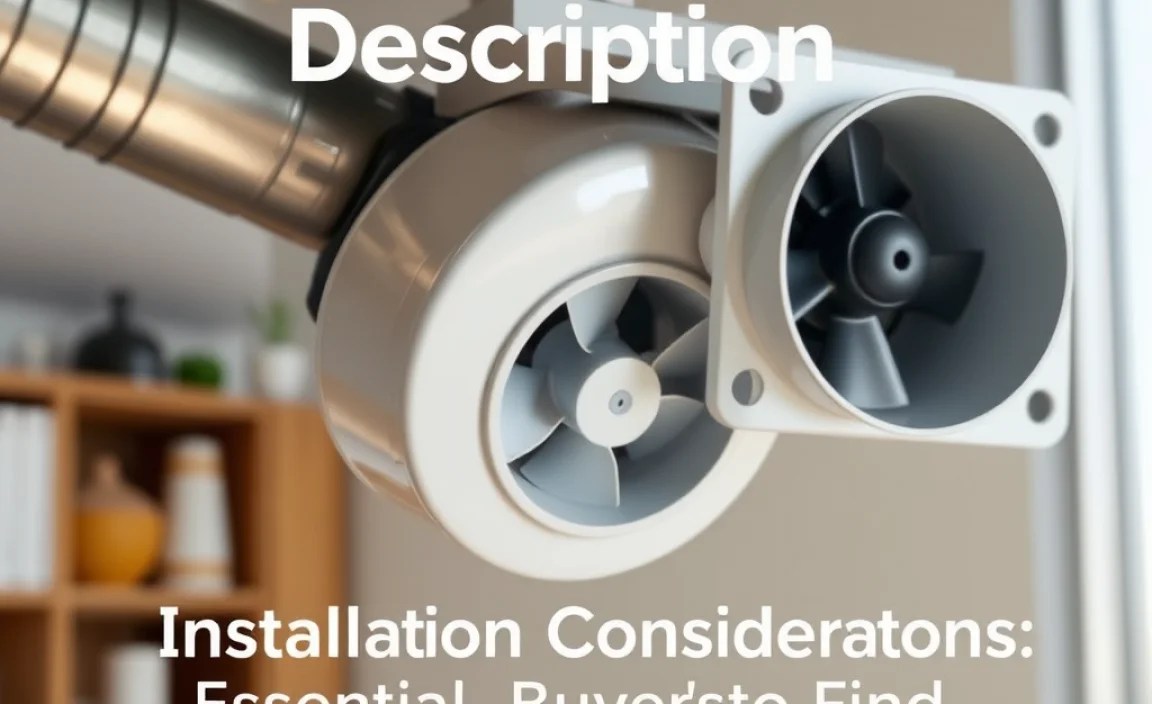
To help visualize the different aspects, here’s a table summarizing common exhaust fan specifications:
| Specification | What it Measures | Importance | Ideal Range/Considerations |
|---|---|---|---|
| CFM (Cubic Feet per Minute) | Airflow volume | Effectiveness in removing moisture/odors | Match to room square footage (e.g., 1 sq ft = 1 CFM for bathrooms), higher for kitchens. |
| Sones | Sound level perceived | Quiet operation | < 2.0 for most residential, < 1.0 for very quiet areas. |
| Fan Type | Installation location/design | Suitability for room and ducting | Ceiling/Wall (common), Inline (quiet, remote), Window (no ducting), Range Hood (kitchen-specific). |
| ENERGY STAR Rated | Energy efficiency | Lower electricity bills, eco-friendly | Look for the ENERGY STAR logo. |
| Duct Size | Diameter of exhaust outlet | Proper fit with ductwork | Must match required duct size (e.g., 4-inch, 6-inch). |
| Features | Added functionalities | Convenience and performance | Humidity sensors, motion sensors, lights, night lights. |
Installation Considerations: What to Keep in Mind
While this guide focuses on selection, a brief mention of installation is prudent. Proper installation is key to your exhaust fan’s performance and longevity.
- Ducting: Always vent the fan to the outside of your home. Never vent into an attic, crawl space, or wall cavity, as this will only relocate moisture and can lead to serious structural issues and mold growth. Use smooth, rigid ducting for best airflow.
- Location: For bathrooms, position the fan centrally in the ceiling, preferably over or near the shower/tub area.
- Electrical: If you’re not comfortable with electrical work, hire a qualified electrician. Always turn off power at the breaker before any electrical connection.
- Building Codes: Check your local building codes for specific ventilation requirements. Some areas may have stricter rules regarding fan performance or installation.
Resources like the National Association of Home Builders (NAHB) offer valuable insights into building and ventilation best practices.
FAQ: Your Exhaust Fan Questions Answered
Q1: How often should I run my exhaust fan?
For bathrooms, run the fan during and for about 15-20 minutes after showering or bathing to effectively clear out moisture. In kitchens, run it while cooking and for a few minutes afterward to eliminate odors.
Q2: Can I vent my bathroom fan into the attic?
Absolutely not. Venting into an attic or crawl space can cause significant moisture damage, mold growth, and wood rot. Always vent exhaust fans directly to the outside of your home.
Q3: My exhaust fan is old and loud. What should I look for in a replacement?
Look for a replacement with a lower Sone rating (e.g., 1.0 – 2.0 Sones) for quieter operation. You’ll also want to ensure the new fan’s CFM is appropriate for the room size. Consider ENERGY STAR certified models for better energy efficiency.
Q4: Do I need a specific type of exhaust fan for a kitchen?
Yes, kitchens typically require more robust ventilation. Range hoods are designed to capture grease, smoke, and strong odors directly above the cooktop. They have higher CFM ratings and often include filters and lighting.
