
If you’re new to homeownership or tackling a bathroom renovation, understanding different toilet types is key to making a smart choice. This guide breaks down common toilet styles, features, and considerations, helping you select the perfect toilet with confidence and ease.
Upgrading your bathroom or dealing with a toilet issue? It might seem like a simple fixture, but choosing a new toilet can feel surprisingly complicated. With so many options out there, from sleek, modern designs to classic, reliable models, it’s easy to feel a bit lost. Don’t worry! As your go-to for all things DIY and home maintenance, I’m here to break down the world of toilets into easy-to-understand terms. We’ll explore the most common types, what makes them tick, and what to consider so you can make an informed decision for your home. Get ready to feel confident about your selection!
Understanding the Basics: What Makes a Toilet Work?

Before we dive into the different types, let’s quickly cover the main parts of a toilet. Knowing these will help you understand the differences between styles:
- Tank: This is the box-like part at the back that holds the water for flushing.
- Bowl: The basin where waste collects before flushing.
- Rim: The top edge of the bowl.
- Seat: The part you actually sit on; it’s usually hinged.
- Lid: Covers the seat and bowl when not in use.
- Flush Handle/Button: Activates the flushing mechanism inside the tank.
- Flapper: A rubber seal inside the tank that lifts to release water into the bowl.
- Trapway: The S-shaped or P-shaped pipe at the bottom of the bowl that carries waste away to the sewer.
The way these parts work together, especially the tank and its internal mechanisms, is a prime differentiator between toilet types.
The Most Common Toilet Types for Beginners

When you’re starting, you’ll primarily encounter a few main categories of toilets. Let’s break them down:
1. One-Piece Toilets
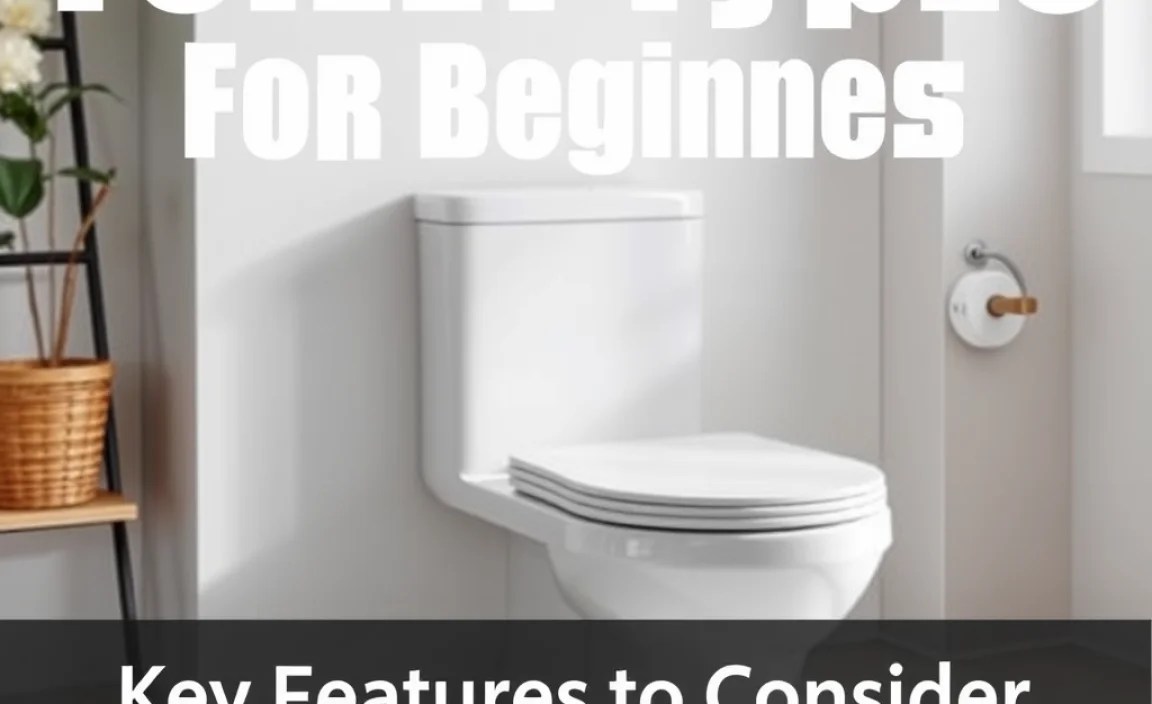
These toilets are exactly what they sound like: the tank and the bowl are manufactured as a single, seamless unit. This design often gives them a sleeker, more modern look.
- Pros:
- Easier to clean due to fewer crevices and seams.
- Generally more durable and less prone to leaks between the tank and bowl.
- Often have a more modern aesthetic.
- Cons:
- Can be heavier and more difficult to install for a beginner.
- If a part breaks (like the tank), the entire unit might need replacement, which can be more expensive.
One-piece toilets are a great choice if you’re looking for a low-maintenance option and don’t mind a slightly more involved installation process.
2. Two-Piece Toilets
These are the most traditional and common type of toilet. As the name suggests, the tank and bowl are separate pieces that are bolted together during installation. This design has been around for a long time and is familiar to most people.
- Pros:
- Generally more affordable than one-piece toilets.
- Easier to install and transport due to their lighter, separate components.
- If one part fails (like the tank or bowl), you can often replace just that specific piece, saving money.
- Wide variety of styles and flushing mechanisms available.
- Cons:
- More crevices and seams, which can make cleaning a bit more challenging.
- Potential for leaks at the connection point between the tank and bowl if not sealed properly.
For beginners, two-piece toilets are often the most practical choice due to their ease of installation and repair. They offer a good balance of cost, convenience, and functionality. You can find them in almost any hardware store and there are tons of replacement parts available if needed. According to EPA WaterSense, choosing an efficient model can also save significant water over time.
3. Tankless Toilets (Direct-Plumbed Toilets)
These are less common in residential settings but are worth knowing about. Tankless toilets, sometimes called direct-plumbed toilets, don’t have a traditional tank. Instead, they connect directly to the water supply line and use the pressure from that line to flush waste. They often require a higher water pressure to function effectively.
- Pros:
- Very compact and can save space.
- Some models are very water-efficient.
- Futuristic look.
- Cons:
- Require high water pressure, which might not be available in all homes.
- Installation can be more complex and may require professional help.
- Limited flushing power compared to tanked toilets if water pressure is insufficient.
- Can be significantly more expensive.
While interesting, tankless toilets are generally not recommended for beginners unless you have specific space constraints and a home with adequate water pressure.
Key Features to Consider
Beyond the basic structure (one-piece vs. two-piece), several features can impact your choice. Understanding these will help you narrow down your options.
1. Flushing Mechanism
This is how the toilet gets the water from the tank into the bowl to clear waste. The most common types are:
- Gravity-Fed: This is the most standard and reliable system. Water from the tank falls into the bowl due to gravity, creating a siphoning action that pulls waste away. Almost all modern toilets use this, but the efficiency can vary.
- Pressure-Assisted: These toilets use compressed air in a sealed inner tank to force water into the bowl with more power. They often have smaller tanks and can be very effective at clearing waste with a single flush. However, they can be louder and more expensive.
- Dual-Flush: Found on many modern toilets, dual-flush systems offer two button options – one for liquid waste (using less water) and one for solid waste (using a bit more water). This is a great way to conserve water. You’ll typically see these on one-piece toilets or as an upgrade for two-piece models.
2. Bowl Shape
Toilets come with two primary bowl shapes:
- Round Bowl: These are more compact and a good choice for smaller bathrooms where space is limited. They are generally less comfortable for adults than elongated bowls.
- Elongated Bowl: These bowls are oval-shaped and longer, providing more seating surface and comfort. They are the most popular choice in many homes but require a bit more space.
When choosing, consider the size of your bathroom and who will be using the toilet. For most adults, an elongated bowl is preferred for comfort. If you have a very small powder room, a round bowl might be the only practical option.
3. Height
Toilet height has become a significant consideration for comfort and accessibility.
- Standard Height: Traditionally, toilets were around 14-15 inches from the floor to the top of the bowl (without the seat).
- Comfort Height / Right Height: These toilets are taller, typically around 17-19 inches from the floor to the top of the bowl (without the seat). They are easier to sit on and stand up from, making them ideal for taller individuals, the elderly, or anyone with mobility issues. This is often referred to as ADA-compliant height, though specific regulations apply.
For most beginners, a “comfort height” toilet is a good ergonomic choice, offering increased ease of use.
4. Rough-In Measurement
This is a crucial measurement for installation and often overlooked by beginners. The “rough-in” refers to the distance from the center of the floor drain (where the toilet bolts connect) to the finished wall behind the toilet. The standard rough-in measurement is 12 inches. However, some toilets are designed for 10-inch or 14-inch rough-ins, and some offer adjustable rough-ins. It’s vital to measure your existing setup before buying a new toilet to ensure it will fit. This Old House provides excellent visual guides for measuring this.
How to Measure Rough-In:
- Ensure your existing toilet is removed or there’s clear access to the floor bolts.
- Use a tape measure to measure from the center of the floor bolts (the bolts that are visible on the base of the toilet, holding it to the floor) straight to the finished wall behind the toilet tank.
- If you have a baseboard, measure to the face of that baseboard, not the wall behind it.
- If the measurement is exactly 12 inches, you can choose almost any toilet.
- If it’s significantly different, you’ll need to find a toilet specifically designed for that rough-in distance.
5. Water Efficiency (Gallons Per Flush – GPF)
Modern toilets are much more water-efficient than older models. Older toilets might use 3.5 to 7 gallons per flush (GPF), while newer ones are required to use no more than 1.6 GPF. WaterSense-labeled toilets use 20% less water than the federal standard (1.28 GPF) and still provide excellent performance. Choosing a water-efficient toilet can save you money on your water bill and is better for the environment.
The U.S. Environmental Protection Agency’s (EPA) WaterSense program certifies toilets that meet high-performance and efficiency standards, typically using 1.28 gallons per flush or less.
Comparing Toilet Types: A Quick Reference
Here’s a table summarizing the main differences between the most common types to help you decide:
| Toilet Type | Description | Ease of Installation | Maintenance/Cleaning | Cost (General) | Best For |
|---|---|---|---|---|---|
| One-Piece | Tank and bowl are a single unit. | Slightly harder (heavier). | Easier (fewer seams). | Higher | Modern aesthetics, easier cleaning, durability. |
| Two-Piece | Tank and bowl are separate pieces bolted together. | Easier (lighter, separate parts). | Slightly harder (more seams). | Lower to Medium | Beginners, budget-conscious, ease of repair. |
| Tankless | Directly connected to water line, no tank. | More complex (may need pro). | Easier (fewer parts). | Highest | Specific space needs, high water pressure homes. |
Choosing the Right Toilet for Your Needs

Now that you know the types and features, let’s put it all together to help you make the best choice. Consider these factors:
1. Your Experience Level with DIY
Are you comfortable with heavier lifting and precise alignment? A one-piece toilet can be installed by a confident DIYer, but it’s a two-person job for most. If you’re new to plumbing or prefer simpler tasks, a two-piece toilet is the way to go. They are lighter, easier to maneuver, and the assembly is straightforward. Remember to get a new wax ring and flange bolts for a secure seal – these are essential for preventing leaks.
2. Bathroom Size and Layout
Measure your bathroom! Does a standard-sized toilet fit comfortably, or do you need a compact model? A round-bowl toilet or a compact elongated bowl can be great for powder rooms or very tight spaces. Ensure there’s enough clearance around the toilet for comfortable use and cleaning. For the rough-in, as mentioned, ensure it matches your existing plumbing. If you’re unsure, a 12-inch rough-in is the most common and gives you the widest selection of toilets.
3. Comfort and Accessibility
Think about who will regularly use the toilet. For maximum comfort, especially for adults or those with joint issues, a comfort-height (or right-height) toilet is highly recommended. Standard height toilets can feel too low over time. Always try to sit on a display model if possible when shopping. Comfort is key for a fixture you uses every day!
4. Budget
Toilets range widely in price. Two-piece models are generally more budget-friendly upfront. One-piece toilets tend to be more expensive. Special features like pressure-assisted flushing or advanced dual-flush systems can also increase the cost. Don’t forget to factor in the cost of essential accessories like a new wax ring, flange bolts, and a toilet seat if it’s not included.
5. Water Consumption and Environmental Impact
If saving water and reducing your utility bills is a priority, look for a WaterSense-labeled toilet. These models are tested for performance and efficiency, using significantly less water than older toilets without sacrificing flushing power. This is a responsible choice that benefits both your wallet and the planet.
Installation Tips for Beginners
While this guide focuses on selection, a quick word on installation can build your confidence. Replacing a toilet is a common DIY project. The basic steps involve:
- Turning off the water supply to the toilet (usually a valve behind the tank).
- Flushing the toilet to empty the tank and bowl as much as possible. Use a sponge to remove remaining water.
- Disconnecting the water supply line from the tank.
- Removing the nuts from the floor bolts holding the old toilet base.
- Lifting the old toilet off carefully (these are heavy!) and setting it aside.
- Preparing the flange on the floor (clean off old wax, check for damage).
- Setting a new wax ring onto the flange or the new toilet’s outlet.
- Carefully placing the new toilet onto the flange, aligning the bolts.
- Securing the new toilet with flange bolts and nuts (don’t overtighten!).
- Reconnecting the water supply and turning the water back on.
- Testing for leaks and flushing.
For a thorough step-by-step guide with visuals on installation, resources like the Family Handyman are invaluable.
Frequently Asked Questions (FAQ)
Q1: What is the difference between a standard toilet and a comfort height toilet?
A: A standard toilet bowl height is typically around 14-15 inches from the floor to the rim (without the seat). A comfort height or right height toilet is taller, usually 17-19 inches, making it easier to sit down on and stand up from.
Q2: What does “rough-in” mean for a toilet?
A: The rough-in is the measurement from the center of the floor bolts (where the toilet secures to the floor) to the finished wall behind the toilet. The most common rough-in size is 12 inches, but 10-inch and 14-inch rough-ins also exist.
Q3: Are one-piece toilets really better than two-piece toilets?
A: “Better” depends on your priorities. One-piece toilets are easier to clean and often look more modern. Two-piece toilets are generally cheaper, easier to install for beginners, and easier to repair by replacing individual parts.
Q4: How much water does a new toilet use?
A: Modern toilets, especially WaterSense-labeled models, use 1.28 gallons per flush (GPF) or less. Older toilets can use anywhere from 1.6 GPF upwards to 7 GPF.
Q5: What are the benefits of a dual-flush toilet?
A: Dual-flush toilets offer two flushing options: a partial flush for liquid waste (using less water) and a full flush for solid waste. This significantly reduces water consumption and your water bill over time.
